

Aston Villa boast a lengthy list of legends from the Villa Park side’s rich history as a club. The Birmingham natives have witnessed and produced a raft of the English game’s finest players.
The ups and downs that add colour to Aston Villa’s history as a club have also made legends who live long in the Villa Park faithful’s hearts. From Charlie Aitken, who made a club record of 660 appearances over a 14-year career, to Billy Walker, who offered a record 244 goals.
Modern day icons like Gabby Agbonlahor and Olof Mellberg have also engraved their names in history. So, Aston Villa News has taken a look at the top 13 Aston Villa legends of all time…
Charlie Aitken

| Position: | Left-back |
| Appearances: | 660 |
| Goals: | 16 |
| Managers: | Joe Mercer (1960-64), Dick Taylor (1964-67), Tommy Cummings (1967-68), Tommy Docherty (1968-70), Vic Crowe (1970-74), Ron Saunders (1974-76) |
| Years at Aston Villa: | 1960-1976 |
No player has ever donned the claret-and-blue shirt of Aston Villa more often than their club legend, Aitken. The left-back recorded a Villans record 660 games between 1960 and 1976. He even helped Villa rise back to the top from the ashes of their relegation into the third tier.
Aitken arrived at Aston Villa on the back of the Birmingham team lifting the 1959/60 Division Two title. But the Villans would endure another relegation from the top-flight come 1966/67 and even fell into Division Three for the 1970/71 term. Yet Aitken remained loyal to the club.
Joe Mercer initially signed Aitken on trial after the Scot learnt his trade at Gorebridge Juniors and Edinburgh Thistle. Little may he have known that the defender would go on to start 657 of his club-record appearances. He even helped Villa qualify for the 1975/76 UEFA Cup term.
Managers came and went at Villa Park but Aitken remained an integral cog of their first-team squad for 17 seasons. His positional sense ensured tacticians turned to the full-back capable of producing perfectly-timed challenges. Whilst his leadership even warranted the captaincy.
Paul McGrath
| Position: | Centre-half |
| Appearances: | 323 |
| Goals: | 9 |
| Managers: | Graham Taylor (1989-90), Jozef Venglos (1990-91), Ron Atkinson (1991-94), Ron Atkinson (1994-96) |
| Years at Aston Villa: | 1989-1996 |
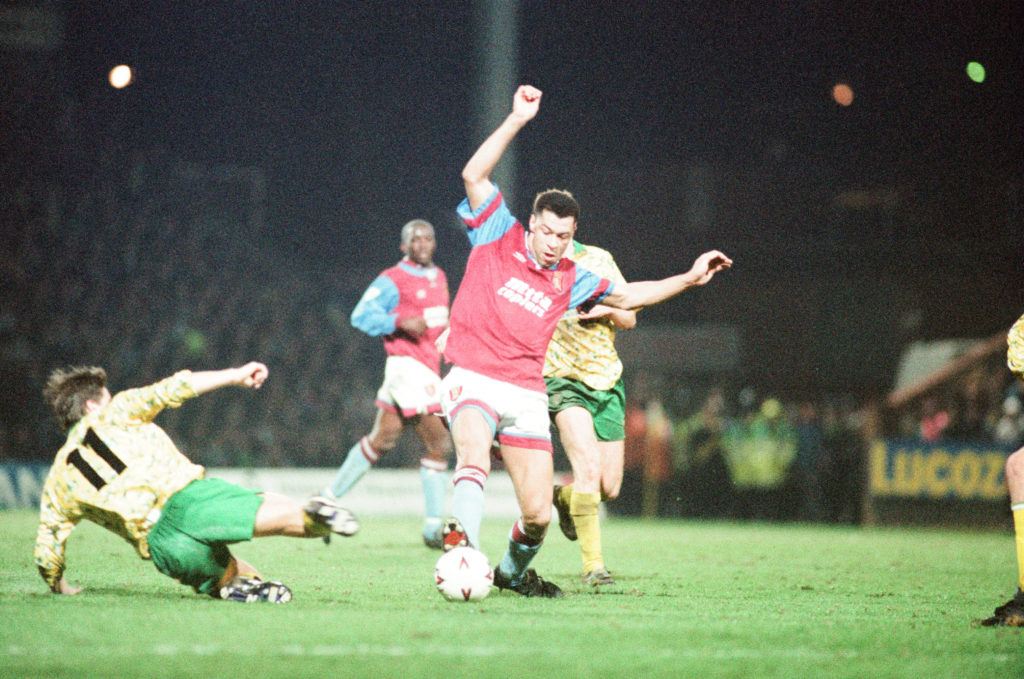
For many Aston Villa supporters, Paul McGrath is the absolute modern-day great and an all-time legend of the claret-and-blue club. The Irish enforcer was a dominant force at Villa Park for seven years. He also made defending an art form after overcoming a shaky start in 1989.
Off-the-field issues meant McGrath struggled to show why Graham Taylor paid Manchester United £425k for his signature at first. But the centre-half overcame his problems to form a formidable backline beside Derek Mountfield and Kent Nielsen that returned Villa to Europe.
Such was the incredible displays that McGrath enjoyed on a consistent basis thereafter that Aston Villa named him as their Player of the Year in 1990, 1991, 1992 and 1993. The PFA also awarded him their Player of the Year award in 1992/93 after pushing for the Premier League.
A shoulder injury was not going to prevent McGrath from helping Aston Villa win the League Cup in 1993/94, either. And two years later, he returned to Wembley and added the EFL Cup to Aston Villa’s trophy cabinet again. He may have lacked pace but McGrath’s wisdom shone.
Peter Withe
| Position: | Centre-forward |
| Appearances: | 233 |
| Goals: | 92 |
| Managers: | Ron Saunders (1980-82), Tony Barton (1982-84), Graham Turner (1984-85) |
| Years at Aston Villa: | 1980-1985 |
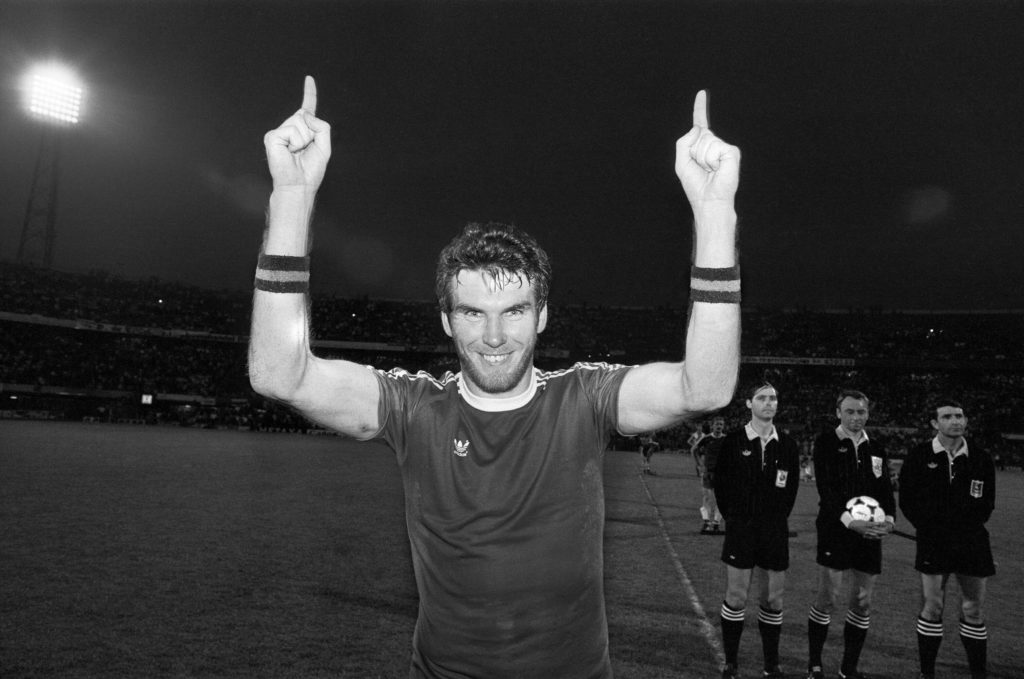
Ron Saunders felt Peter Withe was the final piece of his jigsaw as Aston Villa paid Newcastle United £500,000 for the striker in 1980. It proved to be an immense investment as he repaid the fee tenfold in the following years. First, guiding the Villans to the top-flight title in 1981.
Aston Villa had not won the top-tier title since 1910 before Withe’s goals fired the Villans to glory again. He would not stop there, either, as Saunders’ vision came true in 1982 as Aston Villa won the European Cup. Withe produced the only goal in the final to pip Bayern Munich.
Gary Shaw already ensured Aston Villa’s frontline had pace but Withe’s arrival brought them a forceful finisher. His powerful presence broke defences’ spirits and Withe would ultimately leave having scored 92 goals. Jozef Venglos also brought Withe back as an assistant coach.
Even though White joined Aston Villa when he was 29 years old, the lethal marksman made 11 appearances for England during his time in Birmingham. He had to wait until 1981 for his Three Lions debut but finally earned a shot after scoring 20 goals in Villa’s title-winning term.
Gordon Cowans

| Position: | Midfielder |
| Appearances: | 527 |
| Goals: | 59 |
| Managers: | Ron Saunders (1974-82), Tony Barton (1982-84), Graham Turner (1984-85), Graham Taylor (1988-90), Jozef Venglos (1990-91), Ron Atkinson (1993-94) |
| Years at Aston Villa: | 1974-1985, 1988-1991, 1993-1994 |
Villa Park bore witness to one of the English game’s finest passers to date whenever Gordon Cowans laced up his boots in Birmingham. The midfielder enjoyed three spells in claret-and-blue as a player. He also returned to the Villans as a senior member of Aston Villa’s academy.
Cowans returned to Aston Villa and turned his gifted expertise into helping nurture some of their homegrown heroes. Rising stars learnt from one of the Villans’ most instrumental stars for three decades. His exploits also see Cowans remain one of Villa’s most decorated icons.
After first signing for the club aged 12 on schoolboy terms, Cowans progressed at Aston Villa to win top-flight, European and domestic cup honours. It was likely his early connection with the Villans that saw the midfielder return for three spells as a player and later on as a coach.
Only a broken leg sustained in pre-season in 1983 that ruled him out of the following season ended Cowans’ run of consecutive appearances dating back to 1979, as well. The playmaker went four years without missing a single match and could move the ball with absolute grace.
Dennis Mortimer
| Position: | Midfielder |
| Appearances: | 406 |
| Goals: | 36 |
| Managers: | Ron Saunders (1975-82), Tony Barton (1982-84), Graham Turner (1984-85) |
| Years at Aston Villa: | 1975-1985 |
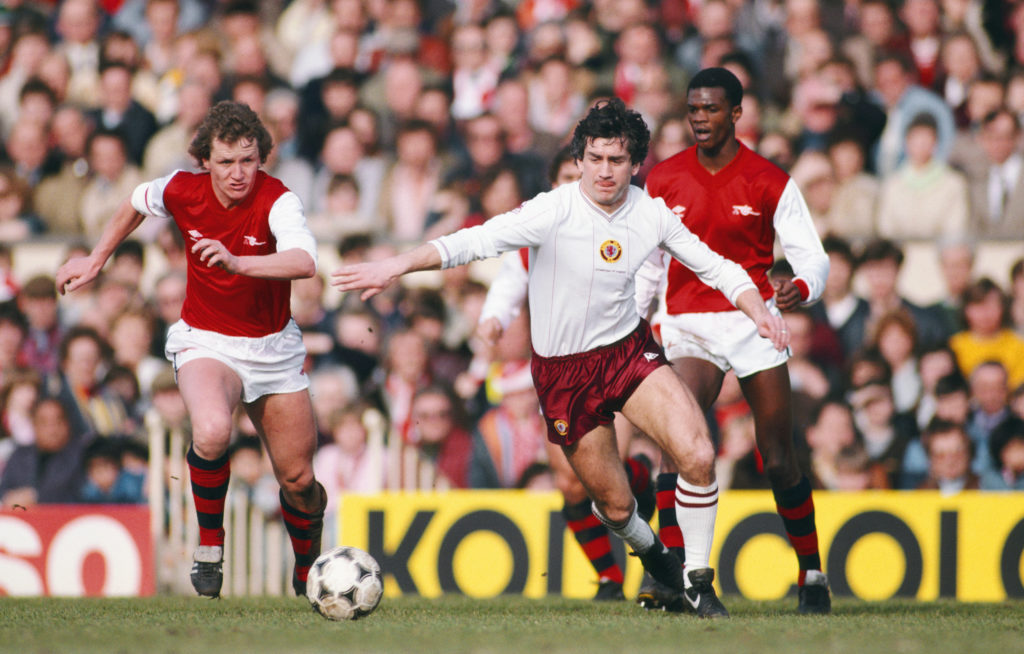
Dennis Mortimer holds his own among the top 13 Aston Villa legends of all time and created one of the defining images in the club’s history. He cemented a place on the pages of Villans’ record books forever more in May 1982 as the Villans captain who lifted their European Cup.
It was also during Mortimer’s spell as their captain that Aston Villa ended their 71-year wait for another top-flight title. While rival teams felt his impact from the very first moment that the Liverpudlian wore a Villans shirt in 1975 after a powerful display to help beat West Ham.
A decade at Villa Park saw Mortimer establish his undisputed authority as a driving force for some of Villa’s greatest sides to date. Yet England managers forever overlooked his talent at the senior level. The Coventry product only ever represented his country’s U23s and B-team.
What Mortimer achieved in claret-and-blue ensured Saunders’ move on Christmas Eve back in 1975 acted as a long-lasting present. While the gift of his genius came to the fore with the Villans that Boxing Day. Two assists in the 4-1 win over West Ham was the start of his myth.
Peter McParland
| Position: | Outside left |
| Appearances: | 341 |
| Goals: | 121 |
| Managers: | George Martin (1952-53), Eric Houghton (1953-58), Eric Houghton (1958-62) |
| Years at Aston Villa: | 1952-1962 |
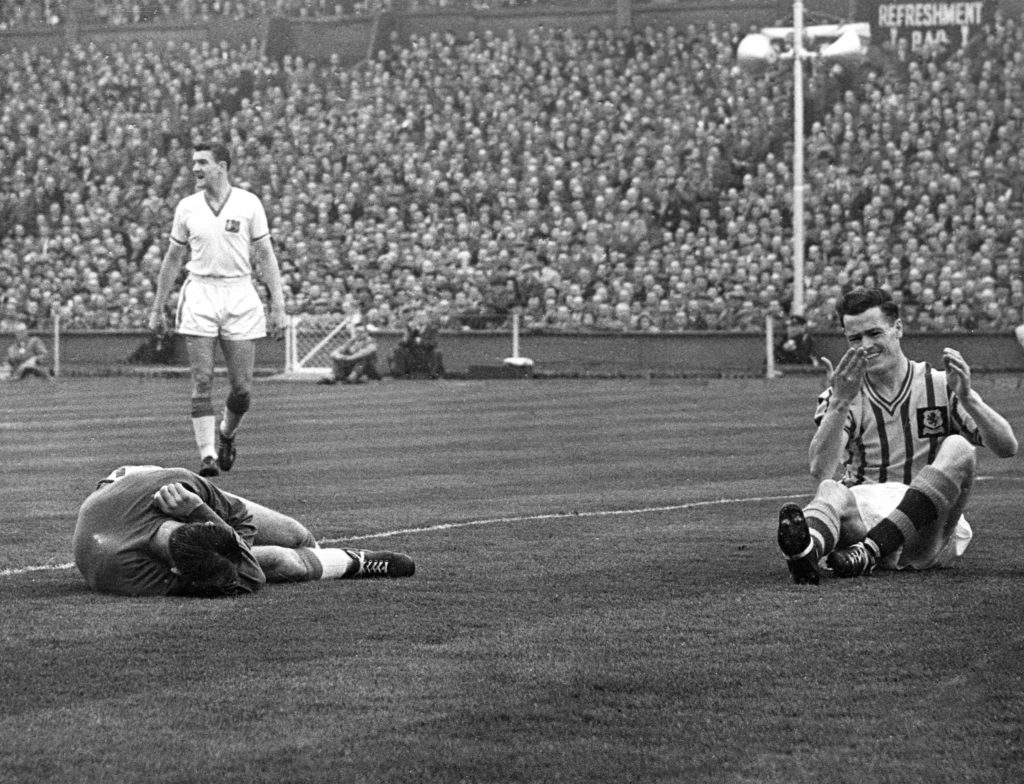
Peter McParland cemented his right to be remembered as an Aston Villa legend in the 1957 FA Cup final. But the outside left forward was more than just one match at Wembley for the Villans. He was the big-game player who helped to create a true spell of delight at Villa Park.
Aston Villa fans remember the Northern Ireland international as their hero at Wembley after McParland scored both goals in a 2-1 win over Manchester United. But he was the villain for the Red Devils after colliding with Ray Wood and fracturing the goalkeeper’s cheekbone, too.
Aston Villa legend Peter McParland was a big-game player
The Old Trafford natives were hot favourites to win at Wembley as Busby’s Babes targeted a domestic double. Yet McParland spoiled their party after a forceful collision left Wood just a passenger and centre-half Jackie Blanchflower forced into the United goal after six minutes.
His collision with Wood defined McParland’s legacy for some but he built his icon with Aston Villa thereafter. The attacker from Newry helped the Villans return to the top-flight in 1960. He also hit the extra-time goal that made Aston Villa the first EFL Cup winners one year later.
Billy Walker

| Position: | Inside-left forward |
| Appearances: | 529 |
| Goals: | 244 |
| Managers: | George Ramsay (1914-26), W J Smith (1926-33) |
| Years at Aston Villa: | 1914-1933 |
McGrath, Cowans and co can often lead any discussions over the greatest Aston Villa legend of all time. But Walker set the record books alight in the pre-war era and continues to be the Villan’s club-record goalscorer. No Villa player has ever yet managed to beat his 244 strikes.
An astounding amount of Walker’s goals also came through hat-tricks with 12 trebles across league and FA Cup games. He even had stints playing in goal with the Birmingham outfit and for England. While Walker also captained both Aston Villa and his country during the 1920s.
It was Walker and 10 others whenever Aston Villa’s legendary secretary George Ramsay and his successor, W J Smith, posted a teamsheet. While the Villa Park faithful would chant ‘give it to Walker’ whenever the Villans came forward in attack sensing something great from him.
Defenders had no answers for Aston Villa legend Billy Walker
Nothing could stop Walker in his prime from dismantling defences and his brilliance rose to the fore from his debut. The inside forward had to wait for January 1920 to make his senior bow. But he showed his potential straight away with both goals for a 2-1 win in the FA Cup.
An FA Cup winners’ medal followed that season and records began to fall in 1920/21. Walker became the first Aston Villa player to score four times in a fixture on the opening day of the term against Arsenal. He then became their first to score a hat-trick of penalties in 1921/22.
Defenders would seldom have an answer for Walker’s thunderous shot or extravagant body work. His movement ran rings around centre-halves, whilst having the talent to create with both feet. Despite the heavy ball of his era, Walker also offered a superb presence in the air.
Johnny Dixon

| Position: | Inside forward |
| Appearances: | 430 |
| Goals: | 144 |
| Managers: | Alex Massie (1945-50), George Martin (1950-53), Eric Houghton (1953-58), Joe Mercer (1958-61) |
| Years at Aston Villa: | 1944-1961 |
Aston Villa had already won the FA Cup six times when they arrived at Wembley in May 1957 to face Manchester United. But a 2-1 win over the Busby Babes meant Johnny Dixon became the Villans’ first captain to take the trophy from the Queen and lift it at the national stadium.
His story with the club began a decade earlier when Dixon wrote to Aston Villa seeking a trial simply because he liked their name. Yet 20 months after his signing the inside forward would score on his debut. Three goals in five games would then secure his place in the Villa line-up.
The following years saw Dixon make 430 appearances in claret-and-blue, whilst scoring 144 goals as a classy inside forward. He further ended four seasons as their top scorer, including in 1951/52 with a personal-best haul of 28. He offered 16 and 14 in the terms on either side.
Aston Villa’s managers of the time took great delight in Dixon’s versatility, too. He could play from any of the attacking positions and make an impact. The forward was often in a class of his own. He also later turned his expertise to helping youngsters as a coach for six seasons.
Gabby Agbonlahor

| Position: | Centre-forward, winger |
| Appearances: | 391 |
| Goals: | 86 |
| Managers: | David O’Leary (2005-06), Martin O’Neill (2006-10), Gerard Houllier (2010-11), Alex McLeish (2011-12), Paul Lambert (2012-15), Tim Sherwood (2015), Remi Garde (2015-16), Roberto Di Matteo (2016), Steve Bruce (2016-18) |
| Years at Aston Villa: | 2005-2018 |
Agbonlahor enjoyed a record-setting 17-year association with Aston Villa after first signing a contract with the club in his youth. The forward also acted as the Villans’ captain twice after taking the armband in 2012 and 2015. He left Villa Park in 2018 before then retiring aged 32.
The Birmingham-born hero first earned their captaincy after Stiliyan Petrov put an indefinite hold on his career due to leukaemia. While Agbonlahor regained the armband ahead of the 2015/16 season. But he later quit as their skipper following the Villans’ relegation that term.
Agbonlahor struggled for form during the 2015/16 season and only offered one goal through 17 Premier League appearances. Yet he bowed out of the top-flight that year as Aston Villa’s top scorer in the Premier League era. His 74 goals in 322 games also remain the club record.
A further 34 assists also feature on Agbonlahor’s record, alongside him winning the Premier League’s Player of the Month award in November 2007. He enjoyed his debut in the division under David O’Leary in March 2006 and scored but would not avoid a 4-1 defeat at Everton.
Olof Mellberg

| Position: | Centre-half |
| Appearances: | 263 |
| Goals: | 8 |
| Managers: | John Gregory (2001-02), Graham Taylor (2002-03), David O’Leary (2003-06), Martin O’Neill (2006-08) |
| Years at Aston Villa: | 2001-2008 |
Olof Mellberg made a lasting impression at Villa Park through his seven-year career in claret-and-blue. The defender was a colossus for the club and even enjoyed a lengthy tenure as the skipper. He would also get a hero’s reception on his return after 15 years away in May 2023.
The 117-cap Sweden enforcer stayed away from Birmingham after leaving the Villans to join Juventus as a free agent. But his legacy remained intact as an Aston Villa legend having more than repaid the £5m he cost to sign. John Gregory lured him to Villa from Racing Santander.
Mellberg also sought to repay the support the Villans’ fanbase showed him during his final appearance away at West Ham. The centre-back arranged for every one of the 3,200 away fans to get a replica shirt. His loyalty remained unaffected by an agreement with Juventus.
From the off, Aston Villa fans knew what kind of player Gregory had signed as Mellberg had an instant impact. He was authoritative from the outset and also remained a dominant force throughout his seven years. Very rarely would Mellberg ever put a toe out of line with Villa.
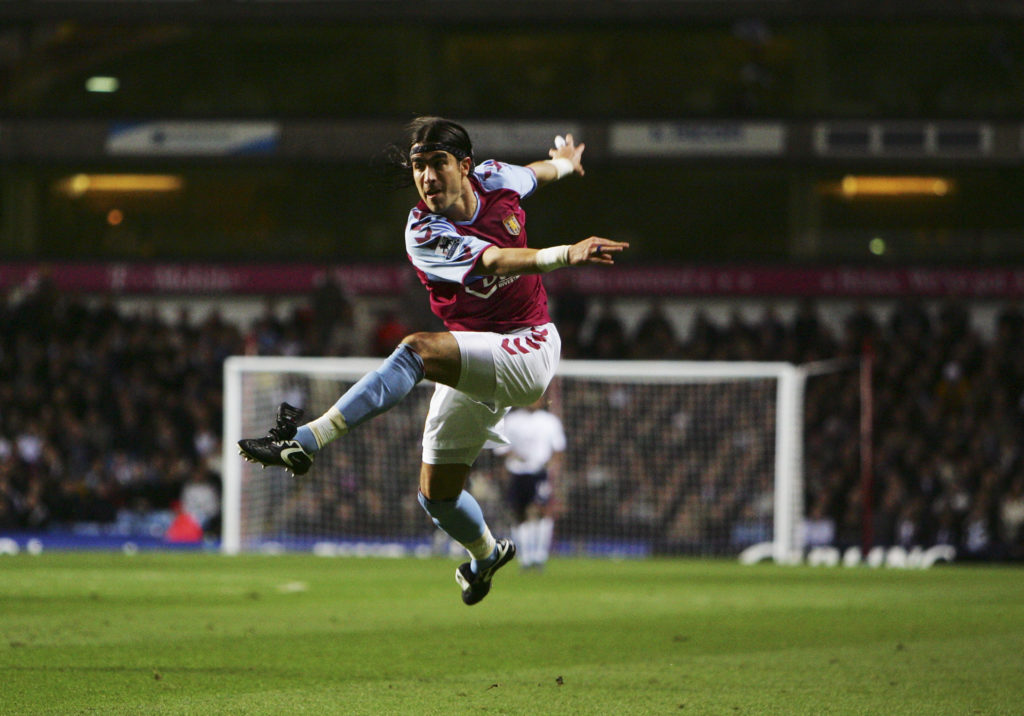
Juan Pablo Angel
| Position: | Centre-forward |
| Appearances: | 205 |
| Goals: | 62 |
| Managers: | John Gregory (2000-02), Graham Taylor (2002-03), David O’Leary (2003-06), Martin O’Neill (2006-07) |
| Years at Aston Villa: | 2000-2007 |
Aston Villa broke the bank to make Juan Pablo Angel a Villans player in December 2000. The Birmingham natives paid Argentinian outfit River Plate a club-record £9.5m for the forward. His switch eclipsed the fee the Villa Park side paid Liverpool for Stan Collymore in May 1997.
Expectations were high for Angel as he left River Plate with a prolific record. But those great hopes did not initially pay off as the Medellin native took time to adapt. He would, however, become an Aston Villa legend before moving to MLS with New York Red Bulls during 2007.
Angel bowed out of Villa Park as a Holte End hero having overcome his early difficulties with the Premier League and the English language. He also had his best games in claret-and-blue under O’Leary. Angel fired Villa to sixth place in the Premier League in the 2003/04 season.
His efforts also guided the Villans into the EFL Cup semi-finals in 03/04 after scoring 23 goals across all competitions. His haul included 16 in the Premier League. But it also proved to be the best that Aston Villa would ever see from Angel, whose form fell away before departing.
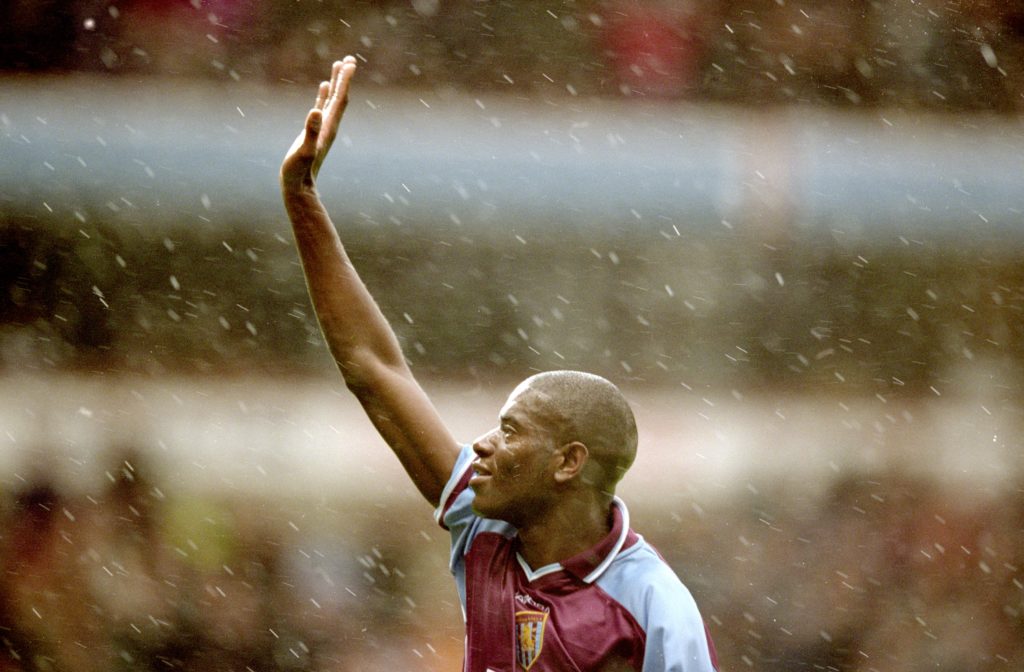
Ian Taylor
| Position: | Midfielder |
| Appearances: | 290 |
| Goals: | 42 |
| Managers: | Brian Little (1994-98), John Gregory (1998-02), Graham Taylor (2002-03) |
| Years at Aston Villa: | 1994-2003 |
Brian Little made Ian Taylor his first signing in charge of Aston Villa after securing a £1m deal with Sheffield Wednesday in December 1994. It also saw the midfielder achieve his dreams as a boyhood Villans fan. He even continued to sit with their fans whenever unable to play.
Taylor even scored on his Villa Park debut to help to a 3-0 win over Chelsea. While his efforts and goal helped Aston Villa to beat Leeds United in the 1996 EFL Cup final. The midfielder hit the Villans’ second effort in a 3-0 win. Taylor later helped Villa reach the FA Cup final in 2000.
Nine years would pass with Taylor enthralling the fanbase of which he was firmly a part. The supporters relished watching a Birmingham-born hero fulfil his dreams and enjoy important displays. But few outweigh his header at the Holte End against Chelsea or volley at Wembley.
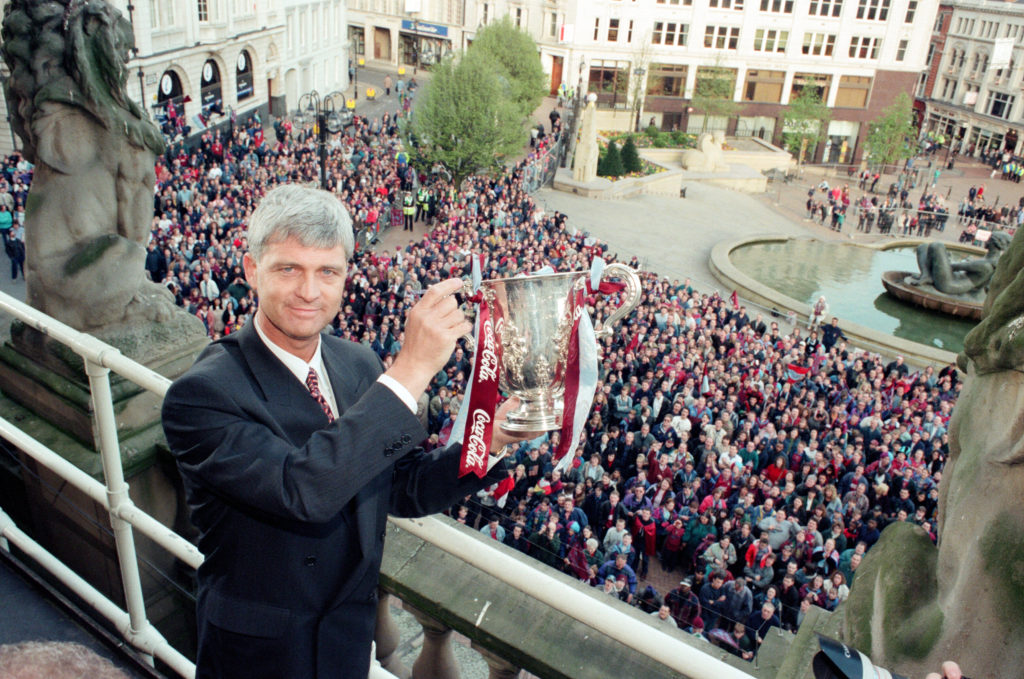
Brian Little
| Position: | Centre-forward |
| Appearances: | 302 |
| Goals: | 82 |
| Managers: | Vic Crowe (1970-74), Ron Saunders (1974-80) |
| Years at Aston Villa: | 1970-1980 |
Little was the one-club man who emerged from Aston Villa’s academy, became a legend and later returned as the manager. He enjoyed a fabled decade as the Villa Park faithful’s adored centre-forward. Four further years would also follow at the Villans’ helm from 1994 to 1998.
All throughout his time in Birmingham, Little also remained an utter gentleman of the game. While his flair could captivate the masses on the field as the forward could create something out of the ordinary. His intelligence and imaginative approach defined the player Little was.
The 1977 League Cup final against Everton also defines Little’s place as an Aston Villa legend. After a goalless draw at Wembley and the 1-1 stalemate after extra time at Hillsborough, the second replay also needed extra time after a 2-2 draw. And it seemed the tie would not end.
But Little found a way in the 119th minute of the third match of the 1977 League Cup final at Old Trafford. The ever-present attacker completed his brace in the final seconds en route to scoring 26 goals that season. It was also his second EFL Cup after lifting the title during 1975.
Little was also Aston Villa’s talisman in 1974/75 to win the League Cup and secure promotion from Division Two. While he returned to their academy upon retiring to work as a coach. The striker born within only a mile of Newcastle United first joined Villa as an apprentice in 1969.


